Most kitchen renovations in South Africa start with a feeling. You stand in the room you already know too well, and you notice the same irritations. The cupboard that never quite closes. The corner that collects clutter. The worktop that’s always too short when guests arrive. It is easy to assume you already understand the space, because you live in it every day.
That familiarity is useful. It’s also the reason so many homeowners miss the details that decide whether a kitchen works for the next ten years or only looks good for the first six months.
A professional kitchen designer is trained to look past the surface. They read the room as a system of movement, storage, light, plumbing and habit. At Easylife Kitchens, that way of seeing has been refined across more than 30 years of luxury kitchen design, custom kitchen cupboards, bespoke built-in cupboards and bathroom vanity design. The result is not a prettier mood board. It’s a kitchen that fits the way your household actually lives.
The room you think you know
Homeowners tend to design from memory. You remember where the kettle sits. You remember the drawer that sticks. You remember the aisle that feels tight when two people cook at once.
Designers measure those memories against facts.
They notice the millimetres that disappear when a door swings the wrong way. They see how a tall fridge will steal preparation space if it is placed first and the rest of the layout is forced around it. They watch how natural light falls across a worktop at 7am and again at 6pm. They ask who unpacks groceries, who packs school lunches, and whether anyone in the house is left-handed.
Those questions sound small. They change cupboard depths, appliance placement and the height of a breakfast bar.
If you are planning a kitchen renovation in Johannesburg, Cape Town, Durban, or Pretoria, this is the gap a local designer fills. National standards matter. So does someone who understands how homes in your area are built and how families in your region cook.
What a trained eye picks up first
Professional kitchen designers South Africa homeowners rely on tend to look for the same handful of problems. They are easy to miss when you are standing in your own kitchen with a tape measure and a Pinterest board.
-
Circulation, not just floor space
A room can look large and still feel cramped. Designers map the path between fridge, sink and hob. They check whether two people can pass without a hip against a handle. They notice where stools will block a cupboard door.
-
Storage that matches real life
A wall of cupboards is not the same as usable storage. Custom kitchen cupboards and built-in cupboards should hold the things you actually own. Deep drawers for pots. A grocery unit for bulk shopping. A narrow pull-out for oils and spices. Vertical space that does not leave the top shelf as a dusty afterthought.
-
Awkward architecture
South African homes come with chimney breasts, boxed-in pipes, uneven walls and windows that refuse to sit where a catalogue kitchen expects them. Bespoke cabinetry South Africa specialists design around those quirks instead of fighting them with filler panels.
-
Services you cannot see
Plumbing, gas, extraction and electrical points decide more of a layout than paint colour ever will. Kitchen installation experts plan the cabinetry around those services so you are not paying twice later.
-
How the kitchen talks to the rest of the house
Open-plan living is common. A designer will ask how the kitchen reads from the lounge, whether the island becomes a dumping ground, and how built-in cupboards in a passage or bedroom can take pressure off the kitchen.
-
Materials that survive daily use
A finish that looks perfect under showroom lighting may mark quickly in a busy family kitchen. Designers balance look, durability and maintenance, which is especially important in luxury kitchen design where the expectation is high.
Why “I’ll just copy that photo” rarely works
Inspiration is useful. Copying a photograph is not a plan.
That image was shot in a different room, with different window heights, different appliance sizes and a different family. The island that looks generous online may leave you with a 900mm walkway that feels like a squeeze. The handleless run that looks calm in a studio may show every fingerprint in a sunny Pretoria kitchen.
Kitchen designers test ideas against your measurements and your habits. They will tell you when a trend is worth it and when it will annoy you by week three. That honesty is one of the quieter benefits of a consultation.
The value of local knowledge inside a national brand
At Easylife Kitchens, we have more than 40 owner-operated showrooms across South Africa and Southern Africa. That network is the point.
You get national manufacturing, consistent quality control and brand guarantees. You also get a kitchen and home designer who works in your area. Showroom specialists in places such as Fourways, Bryanston, Centurion, Edenvale, Faerie Glen, Illovo and Kramerville understand Gauteng property styles and family patterns. Teams in Table View, Tokai, Durbanville, Somerset West, Stellenbosch, Paarl and George see Western Cape light, coastal living and different architectural details. In KwaZulu-Natal, Ballito, Hillcrest and surrounding showrooms deal with another set of homes and climates. Eastern Cape, Limpopo, Mpumalanga and further afield follow the same idea. Local taste, national standard.
If you have been searching for kitchen showrooms near me, that combination is what you should look for. Walk the displays. Open the drawers. Ask why a unit is built a certain way. A good designer will explain the decision, not just sell the finish.
The same thinking applies beyond the kitchen. Built-in cupboards, bathroom vanity design and home office cabinetry all benefit from someone who can see wasted space you have stopped noticing.
What happens when you skip the designer
The short-term saving is tempting. The long-term cost is usually larger.
Typical problems include:
- Cupboards that do not align with tiles or ceilings
- Dead corners that could have been working storage
- Appliances that look integrated but are awkward to use
- Worktops that are beautiful and impractical
- Installations that fight existing plumbing
- A kitchen that photographs well and cooks poorly
Kitchen installation experts exist because precision is not optional. A millimetre out on a run of doors becomes a line you see every morning.
How to use a designer well
You do not need a finished brief. You do need honesty.
Bring photos of what you like and, just as useful, a list of what currently frustrates you. Note how many people cook at once. Mention if you entertain often. Say if you plan to stay in the house or sell in a few years. A designer can plan custom kitchen cupboards for daily life or for resale value, but those two briefs are not identical.
Then let them challenge you. If they suggest moving the sink or dropping an idea you loved, ask why. The answer should be practical.
Start the conversation in person
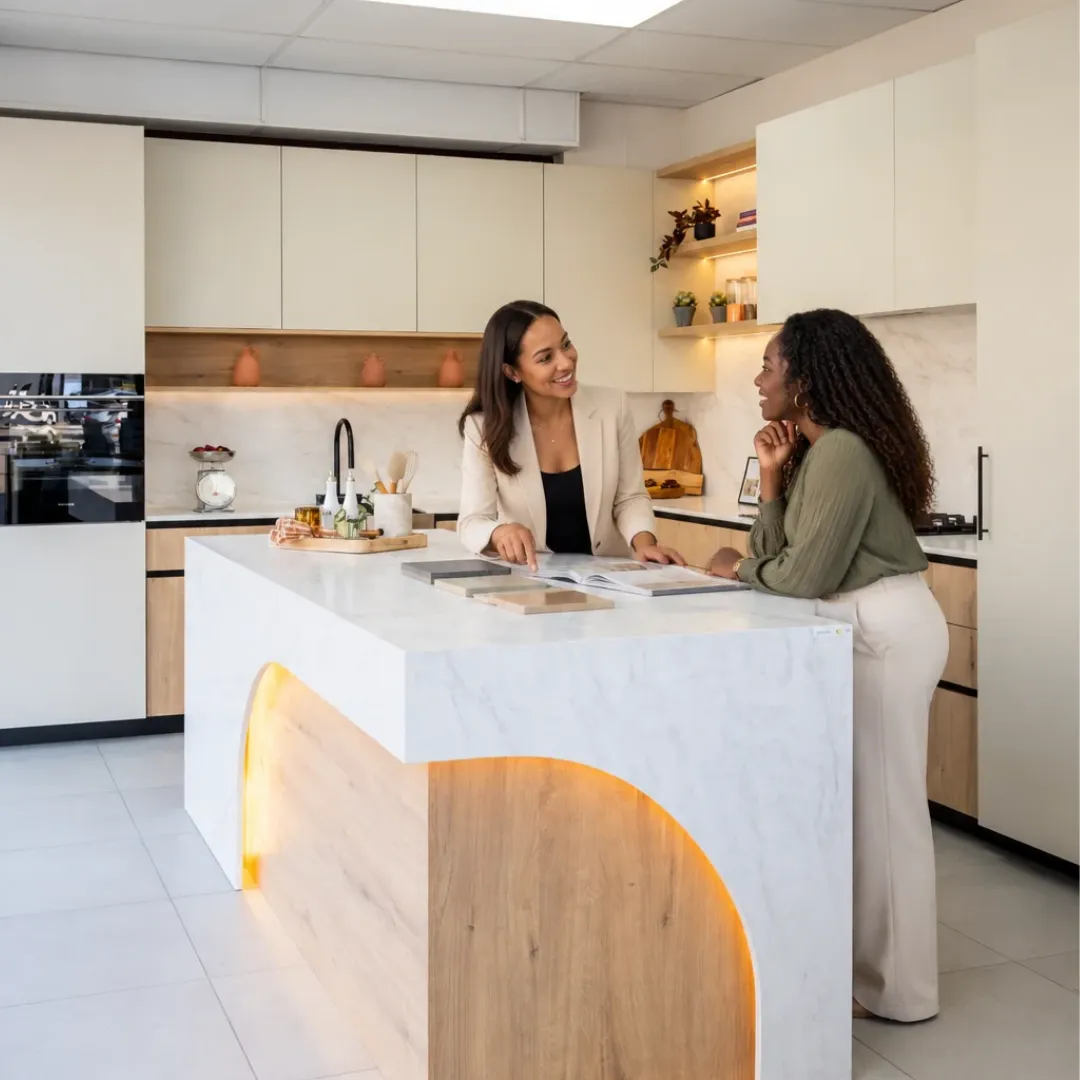
A website can show ranges. A showroom lets you touch door profiles, compare worktop samples and stand in front of a layout that is closer to real life. That’s why Easylife Kitchens still puts so much weight on our kitchen showroom network.
Book a design consultation at your nearest showroom, or enquire online if you want to start with a conversation. Bring your measurements if you have them. If you do not, the team will help you get there.
A professional designer will not take the kitchen away from you. They will show you the version of it you could not quite see from inside the room. That is the difference between a renovation you live with and a kitchen that quietly works, day after day.
Follow us on social media for inspiration, trends, and design tips – Facebook | Instagram | TikTok | Pinterest.